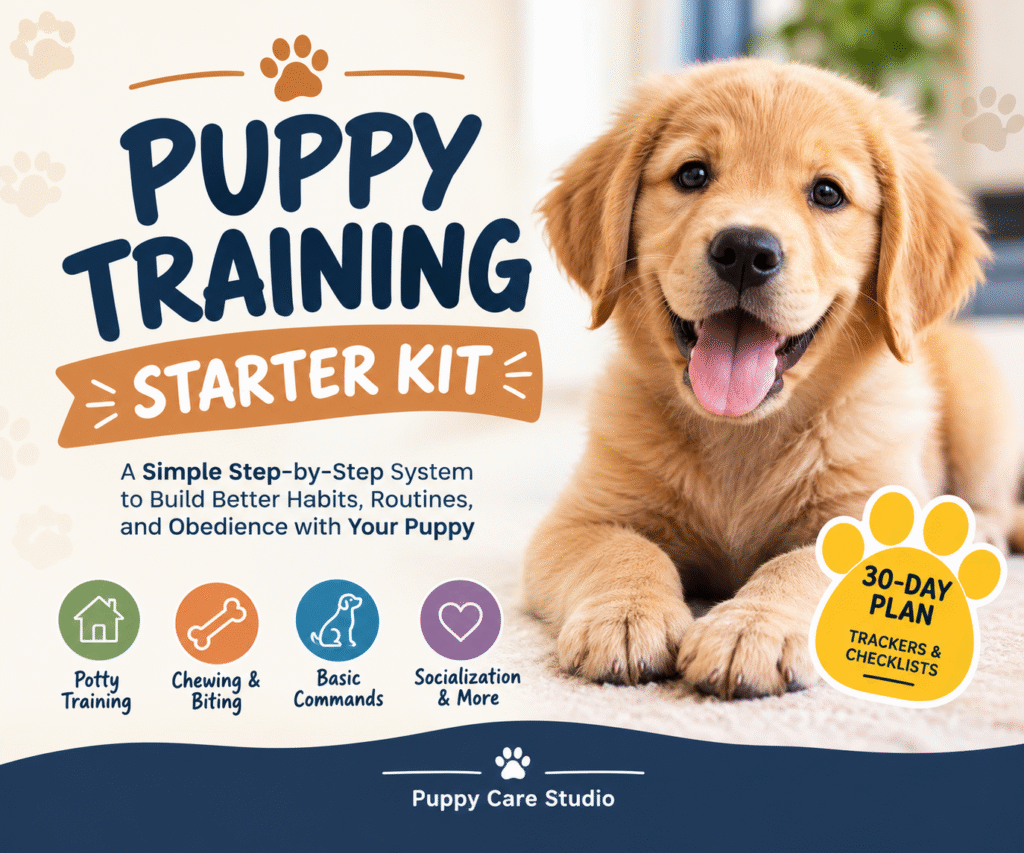
A Simple Training System for a Happier, Better-Behaved Puppy
The Puppy Training Starter Kit gives you simple routines, practical training exercises, printable trackers, and step-by-step guidance to help you build better habits with your puppy — without feeling overwhelmed.
Get the Complete Puppy Training Starter Kit for just $9.90
Instant Digital Access • Printable Workbook • Beginner-Friendly
Start small. Practice consistently. Celebrate the little wins.
Puppy Training Starter Kit
64-Page Digital Workbook · Potty Tracker · Daily Planner · Command Checklist · Progress Tracker
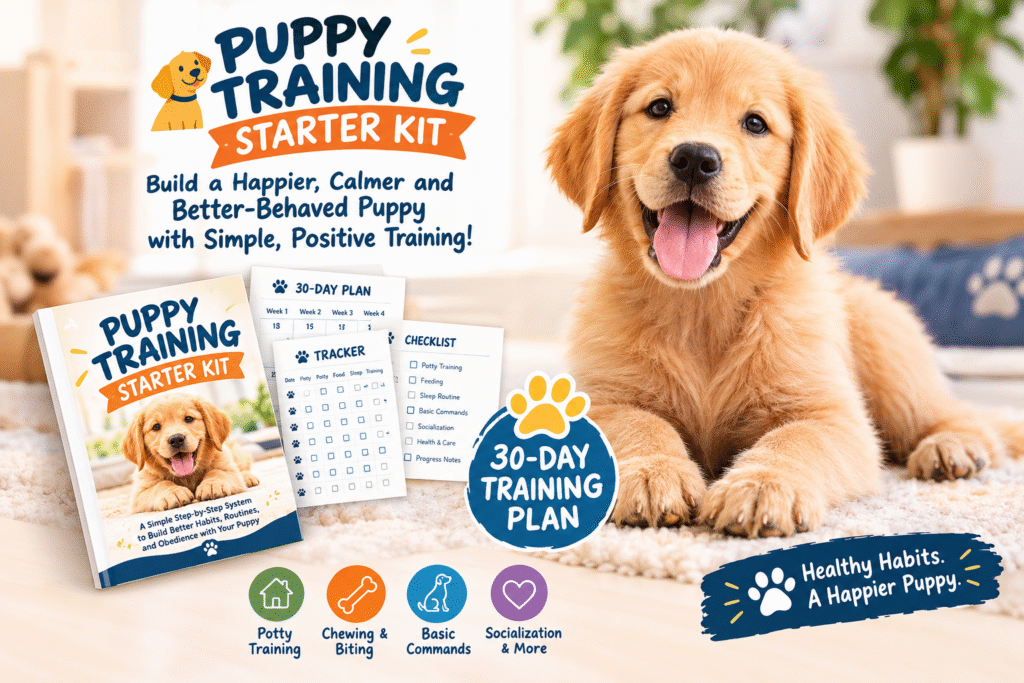
Your Puppy Doesn't Need Perfect Training. You Need a Simple Plan.
Bringing home a puppy can be exciting, funny, tiring, and confusing — often all in the same afternoon. In the early weeks, your puppy is learning where to rest, how to ask for bathroom breaks, what’s safe to chew, and how people respond to mistakes. Some owners run into a few of these along the way:
- Potty accidents, even after progress
- Sharp little teeth on your hands
- Chewed shoes and household items
- Jumping up to say hello
- Pulling hard on the leash
- Getting distracted mid-lesson
- Trouble settling down and relaxing
- Not knowing what to practice next
- Too much conflicting advice online
- No easy way to track real progress
That’s exactly why this kit was created.
Meet the Puppy Training Starter Kit
A practical 64-page workbook designed to help first-time puppy owners create structure, practice foundational skills, and track what is actually working.
It works like a dashboard, not a test.
- Read short, clear teaching sections
- Practice one or two skills at a time
- Print the trackers you'll actually use
- Record the patterns you're noticing
- Review progress and adjust as your puppy grows
Everything You Need to Start Building Better Puppy Habits
Potty Training Guide
When to offer potty trips — after waking, eating, drinking, playing, and before bed — how to read the signs, respond to accidents, and build a routine you can track.
Daily Puppy Routine
A flexible rhythm — morning, potty, breakfast, training, play, nap, afternoon, evening, bedtime — built as a sequence to follow, not a rigid clock.
Feeding Tracker
Organize meal times, food, amount, water, and appetite. Feeding amounts should always follow your vet's or food manufacturer's guidance.
Sleep Routine & Tracker
A calmer bedtime rhythm — predictable wind-down, naps, wake-ups, and notes on what actually helped your puppy settle.
Chewing & Biting Guide
Redirect to appropriate toys, manage the environment, trade instead of chase, and encourage gentle play — plus when to bring in professional help.
10 Essential Skills to Practice With Your Puppy
Each skill gets its own teaching page: goals, what you’ll need, three-step instructions, reward strategies, common mistakes, and progress checkpoints.
Name Recognition
Help your puppy learn that hearing their name is worth paying attention to.
Sit
A simple foundational behavior to practice during everyday interactions.
Down
A calm, settled position that's useful anywhere, anytime.
Stay
Building patience and impulse control, one second at a time.
Come
A recall your puppy is glad to respond to.
Leave It
Teaching your puppy to disengage from something tempting.
Drop It
A friendly trade instead of a chase.
Wait
A pause before doors, bowls, and curbs.
Place
A go-to spot for settling during busy moments.
Loose-Leash Walking
Practicing calmer, more comfortable walks together.

A Simple Training Formula You Can Repeat Every Day
CUE
BEHAVIOR
REWARD
REPEAT
Give one clear cue, wait for the behavior, reward promptly, and repeat in small steps. Rewards can be food, toys, praise, sniffing time, or access to something your puppy wants.
1–3 Minute Training Sessions
Young puppies often do best with very short sessions: 1 minute of connection → 1–3 minutes of skill practice → sniff, chew, play, or nap break.
Help Your Puppy Experience the World With More Confidence
More exposure isn’t always better. The goal is calm, manageable exposure — letting your puppy approach rather than forcing an interaction.
- People
- Sounds
- Surfaces
- Handling
- Car rides
- Household activity
- Grooming
- Collar & harness
- Calm greetings
Talk with your puppy’s veterinarian about the right timing for vaccinations and exposure.
What If Your Puppy Is Doing This?
"My puppy keeps having accidents."
What may be happening: the routine or timing needs adjusting. Try: more frequent, predictable potty trips. Avoid: punishing after the fact.
"My puppy bites my hands."
What may be happening: normal puppy mouthing. Try: redirect to an appropriate toy. Avoid: yelling or rough play.
"My puppy chews everything."
What may be happening: exploring and teething. Try: manage the environment and trade objects. Avoid: chasing your puppy for the item.
"My puppy won't listen."
What may be happening: the cue isn't proofed yet. Try: shorter, simpler practice reps. Avoid: repeating the cue over and over.
"My puppy pulls on the leash."
What may be happening: excitement outpacing training. Try: practice loose-leash steps in short bursts. Avoid: long walks before basics are set.
"My puppy jumps on people."
What may be happening: excitement seeking attention. Try: reward four paws on the floor. Avoid: inconsistent responses from guests.
"My puppy gets distracted."
What may be happening: the environment is too stimulating. Try: practice in a quieter space first. Avoid: jumping straight to busy settings.
"My puppy cries at night."
What may be happening: adjusting to a new environment. Try: a predictable, calm bedtime routine. Avoid: reinforcing crying with excitement.
"My puppy doesn't settle down."
What may be happening: not enough structured rest. Try: scheduled naps and calm wind-downs. Avoid: skipping rest for more stimulation.
"My puppy seems overwhelmed."
What may be happening: too much exposure too fast. Try: slow down and shrink the challenge. Avoid: pushing through a shutdown moment.
This is practical guidance, not a diagnosis. For serious or unsafe behavior, please consult a professional.
Know What to Practice Each Week
WEEK 1
Routine + Name + Potty Foundations
- Setting up a routine
- Name game
- Potty after waking
- Rewarding check-ins
- Meal-to-potty patterns
- Calm crate/bed time
- Weekly review
WEEK 2
Sit + Down + Leave It + Handling
- Sit
- Down
- Leave it
- Paw handling
- Brush introduction
- Combining sit & down
- Review
WEEK 3
Stay + Come + Wait + Leash Foundations
- Stay
- Recall
- Wait
- Harness introduction
- Loose-leash steps
- Recall with toy
- Review
WEEK 4
Combining Skills + Real-Life Practice
- Sit before access
- Down on mat
- Recall with distractions
- Wait at doorway
- Calm greetings
- New safe places
- Celebrating progress
Don't Just Train. Track What Works.
Potty Tracker
Date · Time · Ate? · Drank? · Went Outside? · Success? · Accident? · Notes
Feeding Tracker
Date · Meal Time · Food · Amount · Water · Appetite · Notes
Sleep Tracker
Date · Bedtime · Wake-up · Naps · Notes
Training Progress Tracker
Week · Goal · Reps · Challenge · Next Step
Command Checklist
Started → Practicing → Consistent → Reliable
Socialization Checklist
Experience · Distance · Reward · Comfort · Repeat?
Puppy Milestones
Milestone · Date · What Helped · Confidence · Notes
Vet Visit Tracker
Date · Reason · Questions · Follow-up · Notes
Puppy Information Sheet
Breed · DOB · Microchip · Vet · Food · Medications · Allergies
Your Complete Puppy Training Starter Kit
The 64-page digital workbook includes:
- Puppy Training Fundamentals
- Potty Training Guide + Tracker
- Daily Puppy Routine + Planner
- Feeding Schedule Guide + Tracker
- Sleep Routine Guide + Tracker
- Chewing & Biting Guide + Plan
- 10 Foundational Training Skills
- Basic Commands Checklist
- Responsible Socialization Guide + Checklist
- Training Progress Tracker
- Puppy Milestones Checklist
- Puppy Information Sheet
- Vet Visit Tracker
- Common Puppy Problems Guide
- 30-Day Puppy Training Plan
- Quick Reference Cheat Sheet
- Weekly & Daily Training Planners
- Notes Pages
This Starter Kit Is For You If...
- You are a first-time puppy owner
- You want a simple training routine
- You feel overwhelmed by puppy training
- You want to establish better daily habits
- You need printable trackers and checklists
- You want to know what to practice next
- You prefer short, practical sessions
- You want to track your puppy's progress
This isn’t designed to replace:
- Veterinary care
- Professional dog training
- Veterinary behavior support
- Individualized medical advice
Serious aggression, injury, illness, dangerous behavior, significant fear, or sudden behavior changes should be addressed with the right professional.
Everything Organized in One Simple System
Scattered advice → Random training → No tracking → Unsure what to practice
Simple routine → Step-by-step practice → Track progress → Review → Adjust
TODAY’S PRICE
$9.90
One-time digital purchase
"But I'm Completely New to Puppy Training…"
You Don't Need to Be a Perfect Puppy Owner
You just need a simple plan, a little consistency, and the willingness to keep learning together.
Some days will be smooth. Some days will involve an accident, a stolen sock, or a puppy who suddenly seems to have forgotten every cue. That doesn’t mean you’re failing — it means it’s time to notice, adjust, and try again.
Small steps. Clear routines. More good moments together.
Start Building Better Puppy Habits Today
Get the complete Puppy Training Starter Kit for just $9.90 and start with one simple step today.
Instant Digital Access • 64-Page Practical Workbook • Beginner-Friendly
Frequently Asked Questions
A Practical Resource, Not a Magic Fix
This kit never promises:
- Guaranteed obedience
- Guaranteed potty training
- Guaranteed results in 30 days
- Medical treatment
- Behavioral diagnosis
- Replacement of veterinary care
Instead, it offers:
- Practical guidance
- Consistent routines
- Step-by-step practice
- Progress tracking
- Beginner-friendly organization
- Flexible implementation

Puppy Care Studio
Puppy Training Starter Kit
- Contact
- Privacy Policy
- Terms of Use
- Refund Policy
Digital product. No physical product will be shipped. This resource is educational and does not replace veterinary care, professional training, or individualized veterinary behavior support.